
How What-If Analysis Helped A Hair Salon

Table of Contents
Introduction
The owners of Precision Cuts Salon wanted a more digestible report for their company’s financial performance than trying to make sense of all the numbers on a P&L, Balance Sheet, and Cash Flow Statement separately. Furthermore, they wanted to see how growth might affect their bottom line and how a change in their compensation structure could affect the business. The analysis we did of Precision Cuts Salon’s financial performance and future growth scenarios was conducted using a detailed Excel model that consolidated historical results, key performance indicators (KPIs), and multiple what-if analyses.
Current Performance: KPI Analysis
This KPI dashboard provides a snapshot of Precision Cuts Salon’s existing financial performance and highlights how effectively the business converts revenue into profit. It shows a large increase in sales over the past year and a snapshot of how much in revenue each stylist is generating on average. It then shows a consistent gross profit margin and a 3% increase in net income since last year. We see a breakdown of expenses, particularly the company’s largest expense – labor, its year end cash position, and some key ratios related to debt level, ability to cover current liabilities, and how much return on investments in assets the business is seeing.
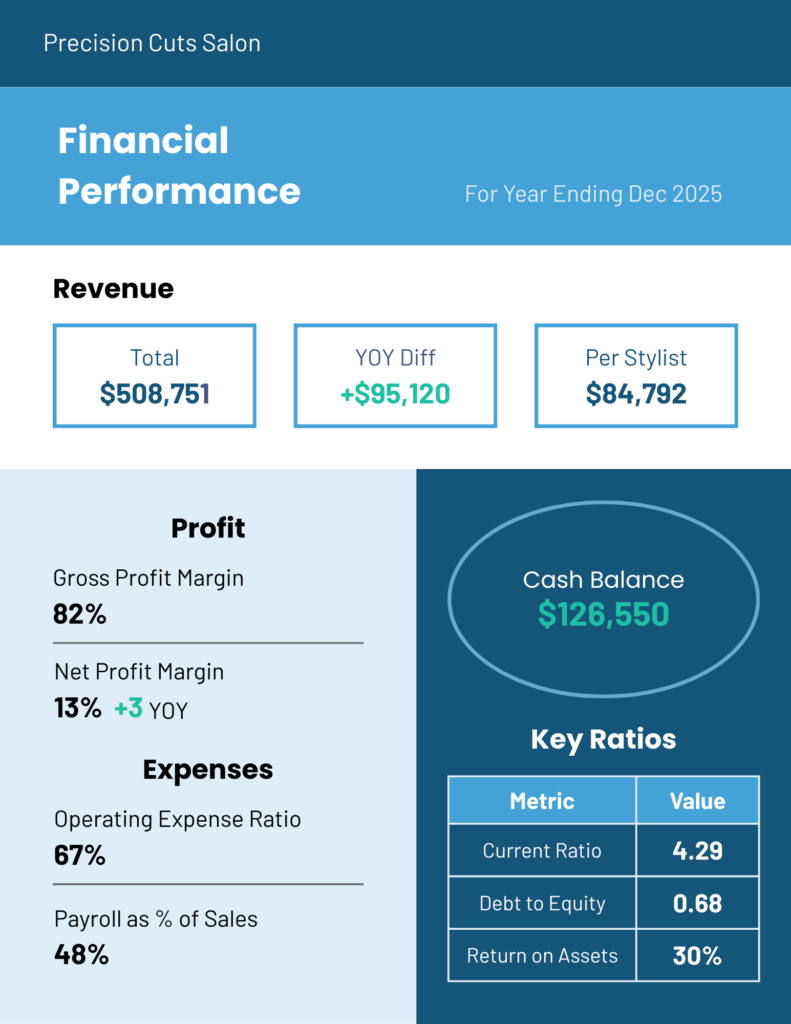
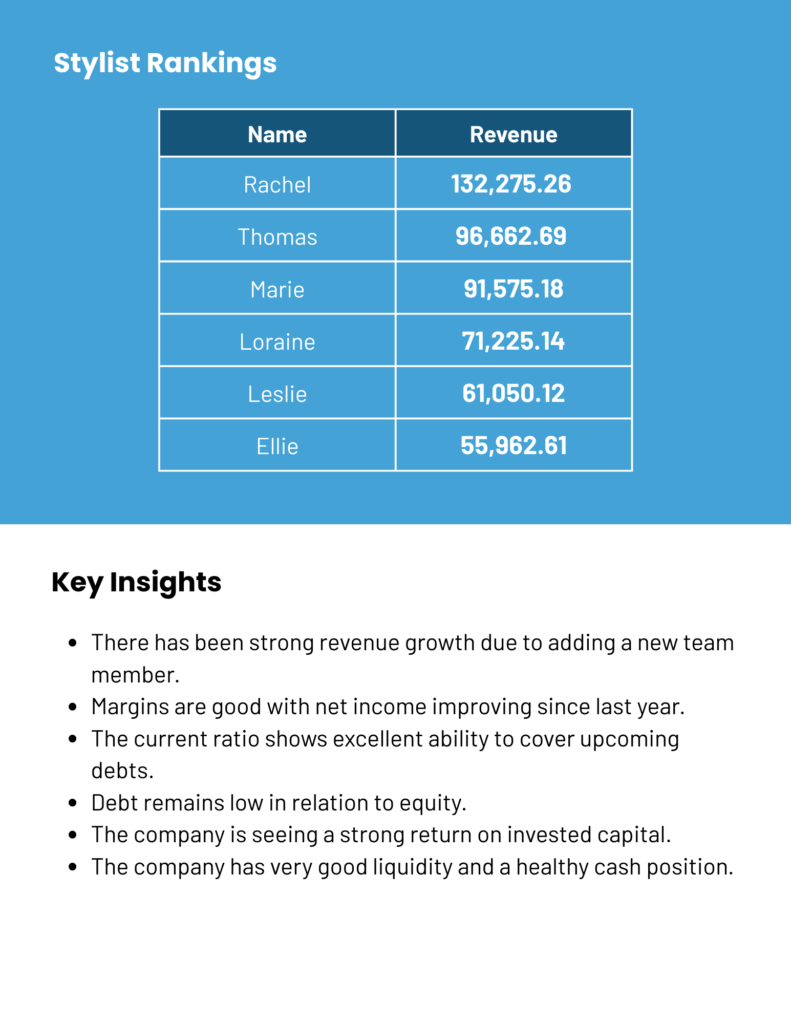
Together, these KPIs paint a clear picture: Precision Cuts Salon is operationally sound, with revenue growth due to hiring another stylist, good margins, excellent ability to cover liabilities, low debt, and a strong return on investments.
This kind of easily readable report format was exactly what the owners wanted. It allows them to find the metrics they care about fast and provides an interpretation of the results that they can understand, unlike having to make sense of traditional financial statements on their own by parsing through rows and rows of numbers and accounts.
Compensation Structure Analysis: Hourly Wages vs. Commission
After discussing the business’s cost structure with the owners, they came to realize how big a change in payroll can be, as labor is by far their most significant expense. When employees are paid by the hour and guaranteed a certain number of hours each week, pay and the corresponding taxes become fixed costs. Fixed costs can be risky and limit growth because they stay the same regardless of how much revenue is coming in.
To convert pay to a variable expense that flexes as sales ebb and flow, a performance based, or commission based, system is required. The owners of the salon began wondering how much of a difference such a change could make for them. So, we put together a retrospective what if analysis, comparing the existing wage based payroll to what pay would have been if each stylist earned a 40% commission on the total revenue they brought in.
In the snapshot from our excel model, you can see that the salon would have saved on labor both years if it had paid on commission. Another thing worth pointing out is that the hourly pay rankings do not coincide with the sales rankings. In other words, the highest earners for the company are not always paid the most. Therefore, a commission based structure would not only help control costs by tying pay to performance, but it would make pay more fair as well.
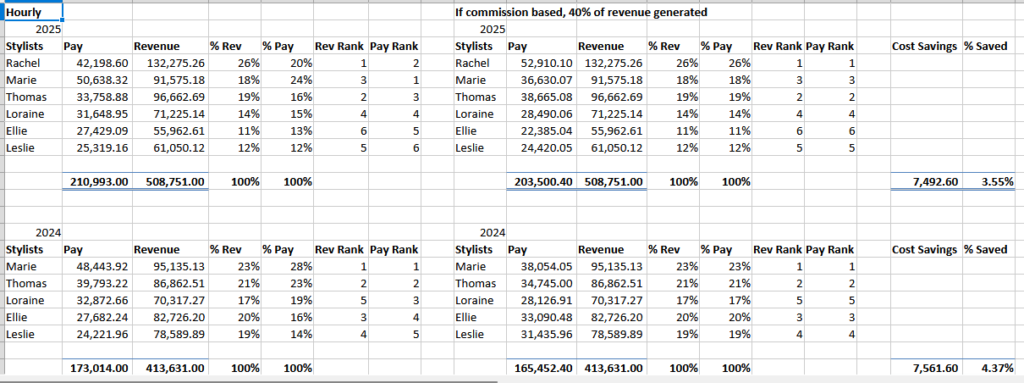
After seeing this, the owners made the strategic decision to test out commission based pay in the coming year. They were able to effectively explain to their staff the benefits, and show how some would have made significantly more the past year if the system had been in place. It also enabled management to encourage more productivity, as they could now demonstrate how improved output would benefit employees.
Expansion and Cost-Volume-Profit Analysis
With a new and productive employee providing a solid boost to the business, the owners of the salon began to wonder if hiring more hair stylists would be a good idea. This would necessitate renting another storefront, however, as their existing location is maxed out on space. They again enjoined AccountAlytix to create a what-if scenario that would give them an estimate of what the company’s profits would look like with an added location and with different levels of staffing – from 4 to 6 new employees.
We used cost-volume-profit (CVP) analysis to evaluate the potential impact of opening a new location and hiring additional stylists. For the model, we relied on several assumptions, including fixed costs being about the same as the existing location except for a bit higher rent, the ratio of variable costs to sales being maintained, and that the new stylists generating the same revenue on average as the existing stylists.
As you can see below, the model spelled out that the company would only do marginally better in sales if it doubled its existing workforce and hired 6 more stylists, but they would fare worse if they hired fewer. Of course, models are prone to error. It could be argued that the estimates are underestimating profit by not showing how much productivity will improve from the new commission based compensation. But projections should be done conservatively, meaning that you want to base them on past performance instead of what might happen.
It could also be the opposite case – that it’s overestimating profits by thinking that a new crop of stylists will be able to produce the same numbers as the current ones, or by assuming that costs for the new location will be similar to the old.
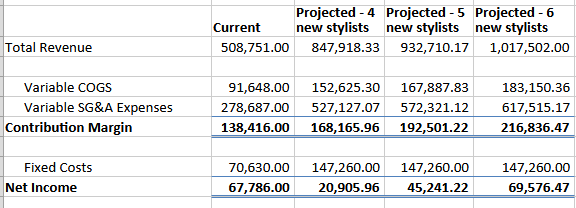
The owners were excited about the prospect of expansion and what it could mean for their bottom line, but it so happens that the numbers don’t bear out that optimism. Cases like this are illustrative of why it’s so important to take the time to do some number crunching before you go all in.
Strategic Outcomes and Conclusion
Doing scenario, or what-if, analysis provided insights that allowed ownership to try out a new compensation model that may end up benefiting them and their employees long-term. And it was able to save the company from making a mistake in thinking that expansion would lead to greener pastures, when in reality it may only lead to more of an administrative headache.
Analysis like this, as well as other forms, can be the difference between improvement and decline, or improvement and stagnation. Make sure that your business utilizes financial analysis to help it succeed and make the right decisions.



I’m really inspired along with your writing talents
as smartly as with the structure on your weblog. Is this a paid theme or
did you modify it your self? Either way keep up
the excellent high quality writing, it is rare to see
a nice blog like this one nowadays..