

Profit Revelations For A Dog Boarding and Training Business

A dog boarding and training service we took on as a client had two revenue accounts in the chart of accounts – Boarding Revenue and Training Revenue. They left expenses aggregated on their income statement and had no idea how much of those costs were associated with each revenue stream. They also weren’t tracking their occupancy rate, retention rate, customer churn, dog stays, training sessions, or training hours. And after hearing that, it should come as no surprise that they weren’t setting any targets for their business either.
The owners of the business confided that they had seen the company stagnate over the past few years, with little growth. Despite their best efforts, they felt like the business had plateaued. They also mentioned that they were less involved currently in day to day operations than in previous years.
We began asking questions and discovered that the business actually has 6 services they offer that equate to 6 revenue segments – 3 under boarding and 3 under training. There’s overnight boarding, full-day daycare, half-day daycare, group session training, private session training, and board and train, for which dogs are boarded for days while undergoing intensive training.
We explained to the couple that owns the company that it would benefit them to break revenue out into the six different segments instead of just the two. My reasoning was that it would allow them to see at a glance how much each revenue stream was generating for them, giving them more visibility into their operations, and it would allow opportunities for more granular analysis that could provide some important insights.

While we were at it, we introduced them to the concept of profit center reporting. In other words, knowing how much profit each business division, department, segment, or in this case – service – is actually making. To do this requires cost allocation. There are a few different ways to allocate costs for a business like this – by percentage of revenue for each segment, by number of dog stays attributed to each service, or labor hours attributed to each one. Labor hours may be the most accurate way, but unfortunately, the company does not track employee hours that way.
We were able to calculate revenue percentage and come up with dog stays for each service, however. We decided that number of stays per service would be the best choice due to it being more indicative of how much employee time was spent on each service.

What the owners knew was that they did far more boarding business than training. Consequently, they had been focusing far more of their marketing on boarding and daycare than on training services. They also knew that their kennels stayed occupied more than they sat empty, but didn’t have an exact figure. Furthermore, they told me that they had actually turned down some training clients in the past, especially for board and train service, due to their kennels being filled by boarding and daycare clients. They didn’t know how many customers they had gained or lost through the past year, though they said there were a few who had gone and several more who had signed up with them.
We put together an analytical model and found that some of the owners’ assumptions were right, but their understanding was very incomplete. And some of their assumptions were just wrong.
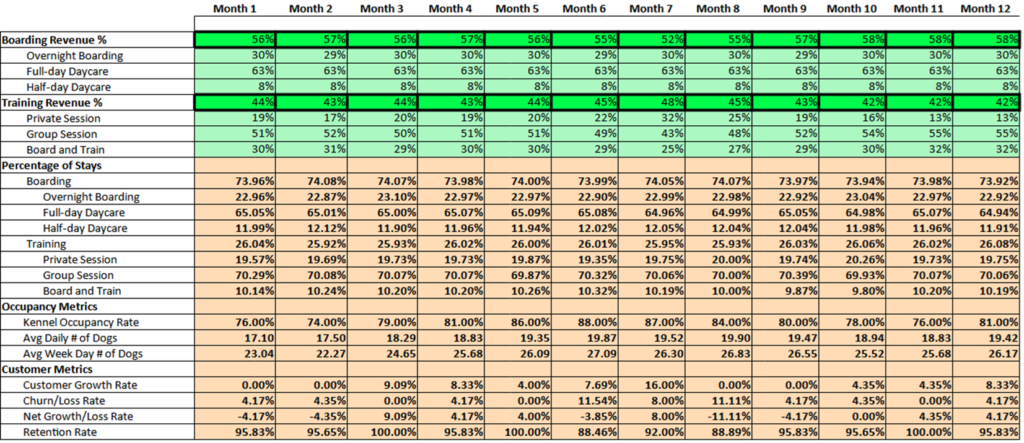

They had an average occupancy rate of 81% over the past year, with slower months dipping into the 70’s. There were 15 new clients gained throughout the year but 14 were lost, netting to a gain of just one client. When we inquired, we found out that they had not reached out to the dog owners who left them to find out why. If they would have had better customer retention, then they would have seen far more revenue growth from the 15 new clients they picked up during the year.
The couple was right about boarding and daycare being their top service, but they didn’t know the whole story. Boarding and daycare represented almost three quarters of dog stays while only a bit over half of all revenue. That was the first tip off that boarding services were not as profitable as training. But the far more telling metric was profit margin. It turned out the daycare services were losing money, with a -10.45% margin for full-day daycare and -65.68% for half-day daycare. Overall boarding related services had a -6.57% margin.

What was actually keeping the business afloat was training revenue, with all 3 related services having margins far better than any of the boarding services. Private session training had over a 50% margin and board and train had a whopping 83% margin.
After presenting the owners with these facts, they were a little frustrated with themselves over missing important points about their business like how the services they spent the most time and effort on were not the key drivers of the business, how they had neglected developing the most profitable segment of their business – training, and how they had ignored customer churn, which led to a low growth rate, as the clients gained were mostly just replacements for those that left.
We explained to them that on the bright side, their new knowledge presented a chance for them to take corrective action. We also explained how setting some targets or goals for their most important metrics would help them direct operations better and help the company improve over time.
Through careful and thoughtful analysis, we were able to introduce the owners to some KPI’s that were new to them, explain the benefits of setting target values for key metrics, and give them a new way of looking at business profit by focusing more on margin than total dollars. In addition, we created a monthly report to give them more in-depth insights than they had ever had, and we provided them with some sobering facts to help drive future decisions.
In the end, they decided to focus more of their advertising efforts on their highest margin services. After evaluating competitor pricing, they decided to raise the rates for their boarding services to achieve better margins. They also decided to focus more on customer service, particularly outreach to customers who left to find out the reasons why and to try and bring them back. Such feedback also aids in finding ways to better the business so that there is less customer churn in the future. And last but not least, they decided to set targets for their business to hit on such things as occupancy rate, customer retention rate, and growth rate.
Since then, the owners have seen improvements in their operations, including revenue and net profit growth. And they’ve seemed more invigorated and invested in their business than when we first took them as a client, when they were somewhat apathetic from the lack of progress of the company.
This case is a prime example of how in-depth analysis and good reporting can directly affect the bottom line for a business. If you think that your company could benefit from help like this, reach out to AccountAlytix here to find out what we can do for you.