
The Hidden Disadvantages of Hiring a CPA Firm for Bookkeeping
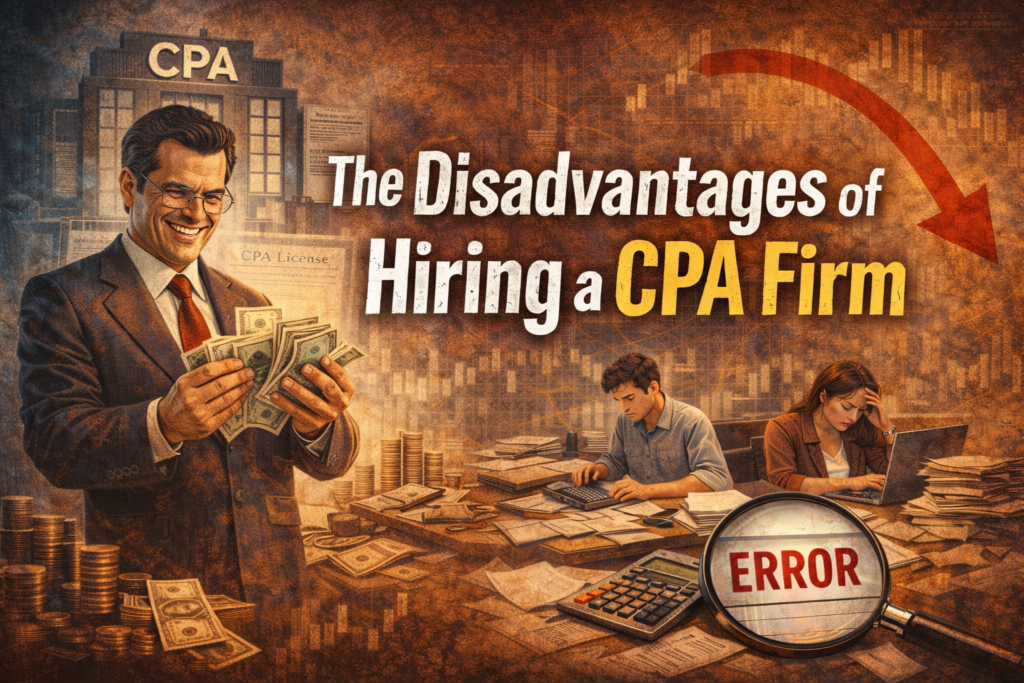
Table of Contents
Certified Public Accountant (CPA) firms enjoy a strong reputation in the business world. To many business owners, the CPA designation signals the highest level of competence, trustworthiness, and financial expertise. This perception is understandable: becoming a CPA requires passing a rigorous four-part examination and meeting strict education and experience requirements. However, the public’s perception of CPA firms does not always align with the reality of how accounting services are actually delivered—particularly when it comes to bookkeeping, payroll, and day-to-day accounting support.
In many cases, hiring a CPA firm for routine accounting services can introduce disadvantages that business owners do not anticipate.
The CPA Exam Does Not Guarantee Superior Bookkeeping Expertise
The CPA exam is demanding, comprehensive, and intellectually rigorous. It tests knowledge across auditing, taxation, financial accounting, and business concepts. Passing the exam demonstrates discipline, technical ability, and a strong understanding of accounting theory. However, success on the CPA exam does not automatically translate into superior practical bookkeeping or operational accounting skills.
Bookkeeping and payroll require accuracy, consistency, system design, software proficiency, and attention to operational detail. These skills are developed through hands-on experience rather than standardized exams. A highly capable non-CPA accountant with years of practical experience may outperform a CPA in bookkeeping execution, even if the CPA has deeper theoretical knowledge in other areas.
CPAs Rarely Perform the Actual Accounting Work
One of the most misunderstood aspects of CPA firms is who actually performs the accounting work. In most firms, CPAs do not directly handle bookkeeping, payroll processing, or account reconciliations. Instead, these tasks are delegated to staff accountants or junior employees.
These staff members are often not CPAs themselves. In some cases, they may not even hold an accounting degree. While many staff accountants are competent and hardworking, the assumption that a CPA is personally handling or closely overseeing every transaction is frequently incorrect. Clients may believe they are paying for CPA-level expertise, when in reality the work is being completed by entry-level or mid-level staff.
Limited Review and Oversight of Staff Work
Another common issue is the level of review applied before financial statements are delivered to clients. While CPA firms typically have internal review standards, time constraints and billing pressures often limit how deeply CPAs review staff-prepared work.
In practice, reviews may focus on high-level reasonableness rather than detailed verification. Errors in classifications, reconciliations, or accruals can go unnoticed—especially for smaller clients who are not considered high-risk or high-revenue accounts. As a result, financial statements may be technically “acceptable” but still contain inaccuracies that reduce their usefulness for decision-making.
Financial Analysis Is Rarely Included
Many business owners assume that hiring a CPA firm automatically includes financial insight and analysis. In reality, most CPA firms do not provide financial analysis as part of standard bookkeeping or accounting engagements.
When analysis is offered, it is often positioned as a higher-level advisory service with significantly higher fees. In other cases, it is not offered at all. This means clients receive historical financial statements with little or no interpretation, context, or actionable insight. Without analysis, financial reports become compliance documents rather than tools for managing and growing the business.
CPA Firms Often Prioritize Tax and Audit Work
Most CPA firms generate the majority of their revenue from tax preparation, tax planning, audits, and attest services. Bookkeeping and payroll are frequently treated as ancillary or lower-margin offerings. As a result, these services may receive less attention, fewer resources, and less experienced staff.
This specialization mismatch can lead to lower-quality bookkeeping outcomes. Firms optimized for tax deadlines and audit engagements may not invest heavily in process improvement, real-time reporting, or accounting system optimization for small business clients. Over time, bookkeeping quality can erode due to lack of focus and prioritization.
Cost Does Not Always Equal Quality
CPA firms typically charge higher hourly rates than non-CPA accounting services. While higher costs can be justified for specialized tax or audit work, they do not necessarily translate into better bookkeeping quality. Businesses may end up paying premium prices for routine services without receiving commensurate value.
Non-CPA accounting services that specialize exclusively in bookkeeping, payroll, and financial reporting often deliver more consistent results at a lower cost. Their business models are designed around operational accounting rather than regulatory or compliance-driven work.
Conclusion: Perception Versus Reality
The CPA designation carries prestige, and CPA firms play an essential role in tax compliance, audits, and complex financial matters. However, when it comes to bookkeeping, payroll, and routine accounting services, the assumption that CPA firms are inherently superior is not always accurate.
In many cases, non-CPA accounting services offer deeper specialization, more hands-on involvement, better process consistency, and more meaningful financial insight. For business owners, the key is not the credential alone, but the structure, focus, and execution of the service being provided.
Choosing an accounting partner should be based on demonstrated expertise, quality of work, level of engagement, and the ability to provide actionable financial insight—not solely on the presence of a CPA license.
AccountAlytix, like other quality services, is not a CPA firm. Priding ourselves on results and the value we can bring to businesses, we ask to be judged by our work and not our credentials. That’s why we allow prospective clients to try us out for 2 months free of charge, with no strings attached. See if you can find a CPA firm that does that.




Good points on the potential downsides of hiring a CPA firm. I think the real issue often comes down less to the CPA label itself and more to the firm’s operating model.
A business can run into problems if the firm is slow to respond, too compliance-focused, weak on communication, or unable to explain what the numbers actually mean. But when the accounting team has strong technical skills, clean workflows, review standards, and the ability to communicate insights clearly, the relationship becomes much more valuable.
For many businesses, the best accounting support is not just bookkeeping, tax prep, or financial statements. It is having people who can spot issues, ask the right questions, document work properly, explain trends, and help the owner make better decisions from the numbers.
So I’d frame it less as “CPA firm or no CPA firm” and more as “does this firm have the right people, process, responsiveness, and advisory mindset to support the business?”