
Most Common Sales Tax Mistakes Companies Make
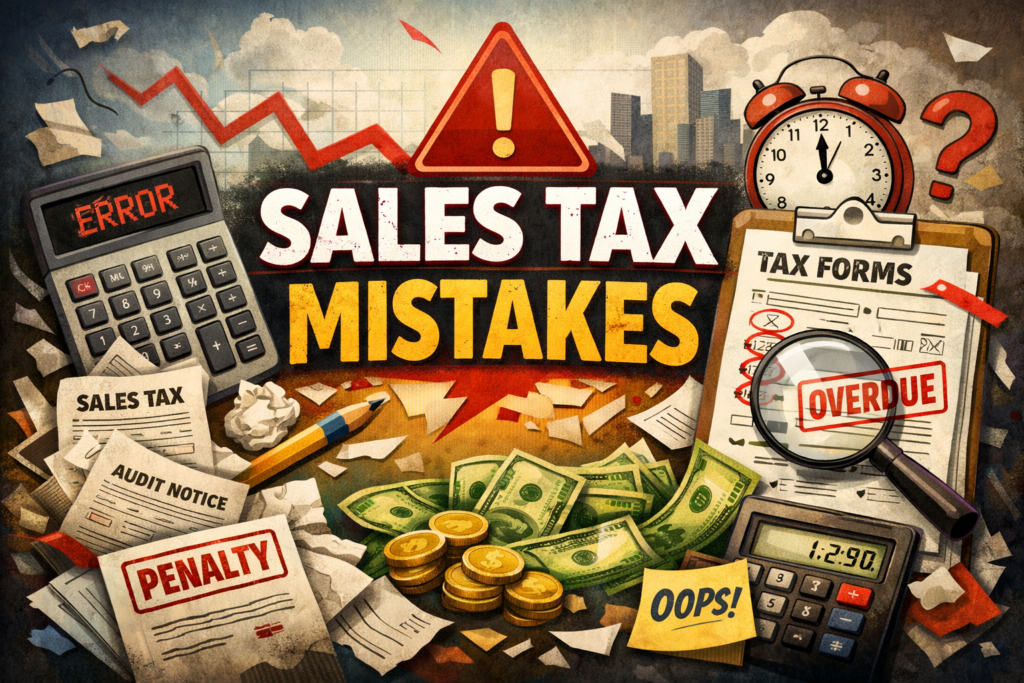
Table of Contents
Intro
Tax laws are always complicated and always a pain, it seems like. For income taxes, people often seek out tax accountants or software programs with all the IRS and state laws built in. For payroll taxes, businesses often outsource to accounting firms or dedicated payroll services like ADP or Paychex, or they use the automated payroll features in QuickBooks Online and similar programs. For sales tax, businesses just as often keep it in house.
They see sales tax as more straight forward – you simply apply your state and local tax rate to the sales total and report and remit to the state. There is no breakdown between social security, medicare, federal withholding, state withholding, and unemployment tax like there is with payroll. And there are not a myriad of different forms with fields that often require research to understand like you get with income tax returns.
It should also be noted that payroll programs make the accounting entries to the correct general ledger accounts for you, and in the case of outsourced payroll, services like Paychex can either integrate with your accounting software or give you a journal entry to upload to it. Sales tax entries aren’t so automated.
The majority of the time, when I work on a new client, sales tax payable and its related accounts are wrong. I’ll list some of the most common errors I’ve encountered, and we’ll talk about why sales tax isn’t as simple as it might seem.
Most Common Issues
Ignoring Nexus
The first thing to pay attention to is whether you have what’s called “nexus” in states in which you do business. Nexus determines whether you will have to register and collect sales tax for that state. Each state can define nexus a little different, but in general, nexus means you either have a physical presence in the state or have a certain volume of sales within the state.
The former is called physical nexus and it involves having a storefront, warehouse, or other facility located there; inventory stored there by a 3rd party; or employees operating in the state, like sales representatives. The latter is called economic nexus and it means your revenue volume in the state exceeds a certain threshold, either total dollars or number of transactions. $100k in sales is typical for economic nexus but thresholds vary by state. So, your business may be legally required to pay sales tax to states you don’t have a physical presence in if you do a lot of business with customers in those states.
Some companies don’t track their sales by state. So, they have no idea what states they have economic nexus in. Some companies have never heard of the concept of nexus. Others understand the concept but they don’t think that any states will find out. But states do find out through things like 1099 reporting, cooperation from the state you reside in, data mining, and audits.
If your business performs a lot of work in another state, in which the service is considered taxable, and your business falls under 1099 vendor rules, that state could easily see how much business you are doing via the 1099’s submitted to it.
If your home state requires you to report out of state sales, your home state could provide that info to other states. With data mining becoming more and more sophisticated, states can harness it to find tax evaders. And if a state has a notion that you may owe them money, they can do a sales tax audit on your company and find out for sure.
They can then figure your back sales tax liability and charge you penalties and interest on what you didn’t report or pay in.
Charging the Wrong Rates
States can be either a destination based or origin based on sales tax. Destination based tax means that you use the tax rate of the location at which the buyer takes possession of the product or in which the service is provided. For instance, if you ship a product, you charge the buyer sales tax at the rate of the city in which they live, because that is where they take possession of it. If the buyer comes to you to pick it up, you charge them the rate of the city your business is in.
Origin based sales tax, on the other hand, means that no matter where the product is shipped or where the service is provided, you charge the customer the tax rate of the city that your business resides in.
Not Including Shipping and Delivery Charges
Some states require sellers to charge sales tax on shipping, freight, or delivery costs that are included in the sales price. The kind of carrier and whether or not the delivery charge is itemized on the invoice can affect taxability as well.
Misunderstanding Taxable Services
Almost all states, except for 5, tax product sales. But what can come as a surprise to some is that many tax services as well. And, like with most other things to do with sales tax, there’s no standardization between states. The types of services that states tax can vary. And the rules can be complex and confusing at times.
For instance, in some states, lawncare for residential property is exempt from sales tax while nonresidential is taxable, but you have to read through several paragraphs to find out that nonresidential properties include apartments, condominiums, and duplexes. While apartments and condos usually have common areas managed by an HOA or POA, duplexes have clearly divided yards that each occupant can be responsible for taking care of. So, why should a duplex be considered nonresidential if the resident is paying?
In some states, landscaping is taxed differently than lawncare. So, you have to know which activities the state considers lawncare and which landscaping – some of their definitions might not be yours.
Another example of confusing and onerous rules is the taxability of services like heating and air installation. In some states, if the property is newly constructed and it’s a first-time installation, it is not taxable. If it’s an existing building, even if it’s a first-time installation, it is taxable. What exactly constitutes newly constructed and existing isn’t touched upon. Is a home that was otherwise completed three months ago new or existing?
To add to the complexity, parts and materials on HVAC units are taxable, regardless of the taxability of installation labor. And you need to account for what hours your employees are putting into installing mechanical and electrical components vs installing duct work, because while mechanical and electrical system installation is sometimes taxable, duct work installation is never taxable.
If you don’t understand the written sales tax rules for your state, call or email your state department of finance and ask for clarification. Getting it in writing is best for defensibility in case you are ever told later on that it is wrong. It’s also a good idea to get the representative’s name and title so that you can reference them if ever having to defend yourself.
Neglecting Use Tax
Use tax is sales tax’s annoying little brother. If you purchase products or taxable services and the company you purchased from doesn’t charge you sales tax when they should have, the burden of reporting and remitting that tax shifts to you.
Many businesses mistakenly think that it’s the seller’s problem, or they simply neglect to analyze invoices and flag them during their accounts payable process.
This happens most often when companies buy products for resale and for internal consumption through the same vendor. The vendor ends up coding all invoices as non-taxable, because they don’t know what you are using versus reselling.
It can also happen when a vendor resides in another state, has no nexus in yours, and their state doesn’t require collecting tax from out of state customers. Unfortunately, many states require use tax be paid on items shipped into the state when tax has not been paid to another state.
Not Using a Sales Tax Payable Account
Many companies don’t use a sales tax payable account to separate out their sales tax collected from their sales. Instead, they leave the sales tax in the revenue totals on their income statement and then include sales tax paid as an expense line. For cash basis bookkeeping, this is common. But ideally, tax liabilities that are not actually an expense for your company should be kept off the P&L. Whereas a company’s portion of FICA taxes and unemployment taxes in payroll constitute expenses because they are paid out of money the business earned, sales tax is money collected from customers for your state department of finance, not an expense paid out of money you earned.
If you want to do cash basis, then modified cash basis, in which key accounts are maintained on the balance sheet, such as loans, payroll liabilities, and sales tax payable, is preferred over strict cash basis. It allows you to see quickly what is owed. It allows you to reconcile those accounts against statements and tax reports to keep them accurate. And it allows you to keep your income statement clean by keeping items that don’t qualify as revenue or expenses off of it.
Not Recognizing Sales Tax Discounts
Many states offer sales tax discounts for paying early or on time. What I’ve seen multiple times when a company has a sales tax liability account is that the sales tax discount each month isn’t accounted for. To give you an idea of what I’m talking about, let’s say you collect $1,000 in sales tax from customers in January. When you go to file January’s sales tax in February, you pay early and receive a 2% discount from the state, or $20. So, you actually end up sending $980 to the state and keeping $20.
Sales tax entries typically look like this:
When collected.
| Debit | Credit | |
| Cash – revenue + sales tax | 10,526.32 | |
| Revenue | 9,526.32 | |
| Sales Tax Payable – owed to state | 1,000 |
When paid.
| Debit | Credit | |
| Sales Tax Payable | 980 | |
| Cash | 980 |
The problem is, nothing is done with the $20 discount. So, it just ends up sitting in the sales tax payable account indefinitely, even though it’s no longer money owed. Month after month this adds up and throws off the balance of your payables account.
The right way to do it is to take the discount to a revenue account because it’s money you’ve been given. An other income or non-operating income account would be best because it was not earned during the normal course of operations by providing services or selling.
What it should look like.
| Debit | Credit | |
| Sales Tax Payable – collected from customers | 1,000 | |
| Cash – paid to state | 980 | |
| Non-Operating Income – sales tax discount | 20 |
The entry above is correct. It clears out the 1,000 collected from January and doesn’t leave a balance there that isn’t actually owed.
Not Recognizing an Expense When Appropriate
So, this may seem a little confusing since I said in the last section that sales tax does not qualify as an expense. Normally, it doesn’t. But there are circumstances in which it does. If you do promotional giveaways of merchandise to customers or provide freebies to employees like free meals or free products, you still have to pay taxes on those items. The problem is, you don’t collect the tax from anybody because the items were given away. So, when you pay, you are paying out of earned income. That constitutes an expense.
Technically, the tax from the situations I just went over is not really sales tax. It is really more like use tax, because the items were used internally by the company for marketing or promotional purposes and for the benefit of employees. But much of the time, businesses report it and pay it out as sales tax.
The mistake I’ve seen is that companies will debit their sales tax liability account for more than what is in the account for that period, leading to a negative balance.
So that you can visualize what I’m saying, let’s go over a quick example. Let’s say $1,000 in sales tax was collected and $1,250 was paid. The sales tax payable account holds 1,000 but is debited for the entire 1,250. This is what it does to the balance of the account.
| Sales Tax Payable Balance | |
| Jan Collected | 1,000 |
| Jan Paid | -1,250 |
| Ending January Balance | -250 |
Negative 250 would indicate that the state owes you back 250 in sales tax. But that’s not the case.
This what the paid entry should look like.
| Debit | Credit | |
| Sales Tax Payable – collected from customers | 1,000 | |
| Promotional Expense – giveaways | 250 | |
| Cash – paid to state | 1,250 |
| Sales Tax Payable Balance | |
| Jan Collected | 1,000 |
| Jan Paid | -1,000 |
| Ending January Balance | 0 |
If you want the payable account to reflect what you actually pay and just what you collected, you can do it like this.
When collected and expense incurred.
| Debit | Credit | |
| Cash – collected from customers | 1,000 | |
| Promotional Expense – giveaways | 250 | |
| Sales Tax Payable – owed to state | 1,250 |
When paid.
| Debit | Credit | |
| Sales Tax Payable | 1,250 | |
| Cash | 1,250 |
| Sales Tax Payable Balance | |
| Jan Collected & Incurred | 1,250 |
| Jan Paid | -1,250 |
| Ending January Balance | 0 |
Just remember, you should never record a paid entry against sales tax payable for more than what it holds for the period at hand. And anything owed over the amount collected is an expense.
Discounts & Returns Not Reflecting Sales Tax
Most point of sale systems are set up to automatically calculate sales tax on the net or discounted price. And most are set up to automatically reflect sales tax when there are sales returns. But when systems are more manual, these things can be missed.
You don’t want to make customers pay more sales tax than they need to because they may catch on and get upset, and because if you report your sales discounts to the state on your sales tax returns, what you will pay will be less than you collected, which, like we discussed with other situations, can cause some accounting mishaps on your books if that excess isn’t removed from the sales tax payable account and taken to the correct account.
Sales returns lower your sales tax liability, too. Whatever sales tax amount you charged when you made the sale, which increased your sales tax liability, should be deducted from your sales tax liability when the item is returned. Failure to do so will screw up your sales tax payable balance and make your books inaccurate.
Conclusion
As you can see, sales tax accounting isn’t always simple and can get messy on your books. State rules can be extensive and confusing. Arkansas’ gross receipts tax rules, for example, contains 171 pages. Of course, a single business wouldn’t need to understand the whole thing, but for some business types, the sections are fairly long and not always easy to understand. Unfortunately, there isn’t any standardization of sales tax rules among states either. They can vary a great deal. That means the more states your business operates in, the more complicated it can get.
Make sure that your business is paying attention to how it calculates and reports sales tax to the states you operate in. The penalties for not doing so correctly can be very costly. And make sure that the sales tax balance on your general ledger is correct. A negative balance or a positive balance exceeding what you have actually collected or incurred is a sign that something is wrong. When lenders, investors, or auditors see things like that, it’s a red flag.
If you find that your business needs help in keeping up with sales tax and making sure it’s right, you can contact AccountAlytix here.